This blog is dedicated to the works of Vincent Van Gogh, Dutch painter and one of the founders of the Post-Impressionist art movement of the late nineteenth century. I began this Van Gogh Sunday feature on my Facebook page and now I'm carrying it in this blog as well. Comments are welcome regarding Van Gogh or Impressionist and Post-Impressionist art!
Showing posts with label painting. Show all posts
Sunday, January 15, 2012
Sunday, December 4, 2011
Sunday, July 31, 2011
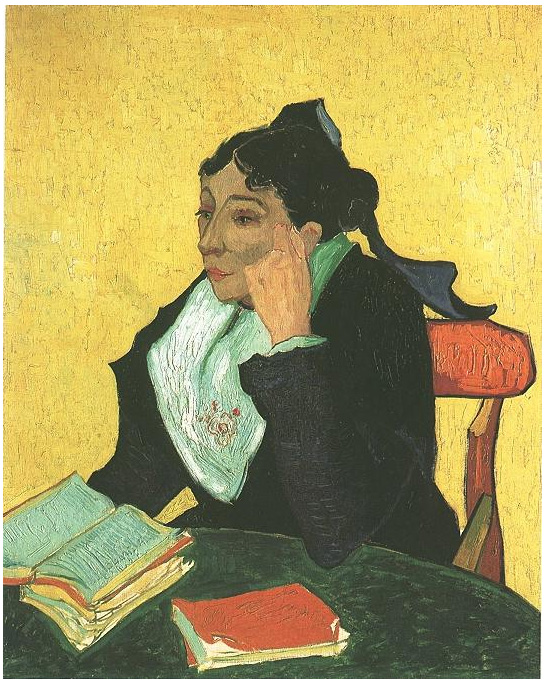
L'Arlésienne: Madame Ginoux with Books - Arles, November 1888 (or May 1889?)
This was one of six similar paintings executed by Van Gogh of Madame Ginoux.
From howstuffworks.com: The portrait depicts Marie Ginoux, proprietress of the Café de la Gare on the Place Lamartine, who came to the Yellow House to sit for Vincent van Gogh and Paul Gauguin in early November.
Marie Ginoux wore traditional Arlesienne costume and posed with an umbrella on the table before her. Vincent van Gogh completed one painting during the hour-long session, while Gauguin worked on a drawing. Vincent later made this version of his portrait, replacing the umbrella with a pile of books.
In a letter to his brother Theo in January 1889, Van Gogh writes briefly about this painting:
Did you during your hasty visit see the portrait of Mme. Ginoux in black and yellow? That portrait was painted in three-quarters of an hour. I must stop for the moment.
M. & Mme. Ginoux were friends of Van Gogh who ran the café which he eventually made famous in a painting entitled Le Café de Nuit and where he lodged when he first arrived in Arles. He later moved to the "yellow house" in which he and Gaugin lived for a time, another place in Arles he immortalized on canvas.
Sunday, July 24, 2011
The Red Vineyard - Arles, November 1888
From Wikipedia: "The Red Vineyard is an oil painting by the Dutch painter Vincent van Gogh, executed on a privately-primed Toile de 30 piece of burlap in early November 1888. It was supposedly the only piece sold by the artist while he was alive.
The Red Vineyard was exhibited for the first time at the annual exhibition of Les XX, 1890 in Brussels, and sold for 400 Francs (equal to about $1,000-1,050 today) to Anna Boch, an impressionist painter, member of Les XX and art collector from Belgium; Anna was the sister of Eugène Boch, another impressionist painter and a friend of Van Gogh, too, who had painted Boch's portrait (Le Peintre aux Étoiles) in Arles, in autumn 1888.
Like The Night Café, it was acquired by the famous Russian collector Sergei Shchukin, was then nationalised by the Bolsheviks with the rest of his collection and eventually passed to the Pushkin Museum of Fine Arts in Moscow.
Ms. Boch, a painter herself, purchased many Impressionist paintings of the time and amassed a significant collection of those artists we admire today."
Sunday, July 10, 2011
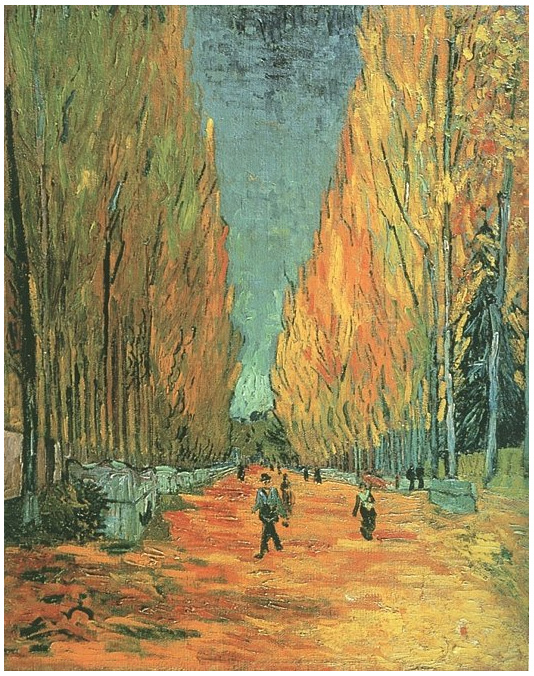
Les Alyscamps - Arles, November 1888, Oil on canvas
From howstuffworks.com: "Vincent van Gogh's 1888 work, Les Alyscamps, was completed shortly after Paul Gauguin arrived in Arles, France, when van Gogh took him to his favorite places to paint. They set up their easels together in the ancient cemetery known as Les Alyscamps (Elysian Fields). In contrast to Paul Gauguin's slow and deliberate process, Vincent van Gogh painted quickly, slashing his pigment on the canvas with thick, broad strokes. This difference became a point of contention between the painters; Vincent van Gogh worked in a rush of emotional energy in opposition to Gauguin's cerebral, considered approach."
Sunday, July 3, 2011
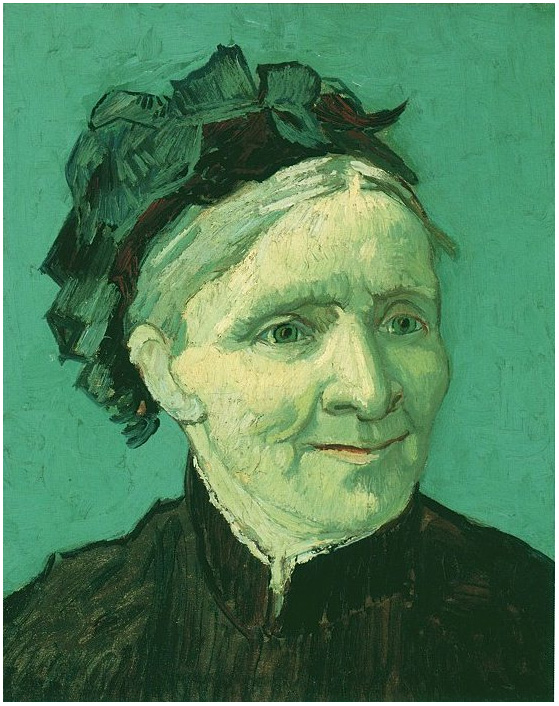
Portrait of the Artist's Mother - October 1888, Oil on canvas
From the Norton Simon Museum site: "By the autumn of 1888, Vincent van Gogh had settled into his Yellow House in Arles, and at the end of October he would welcome Paul Gauguin in what he hoped would become an artist’s collective—a “Studio ...of the South.” Portraits were on the Dutchman’s mind, as not only had he exchanged self-portraits with Gauguin, Émile Bernard and Charles Laval that same month, but he had also set out to complete a series of family portraits. According to van Gogh’s letters to his brother, Theo, this portrait of their mother was based upon a black-and-white photograph. Of the portrait, the artist wrote, “I am doing a portrait of Mother for myself. I cannot stand the colorless photograph, and I am trying to do one in a harmony of color, as I see her in my memory.” Despite his intent to liven up her visage with his palette, van Gogh created a nearly monochromatic version—in a pallid, unnatural green. Nevertheless, this preeminent figure in the artist’s life sits attentive and proud—a model of middle-class respectability."
Subscribe to:
Posts (Atom)